HMFE
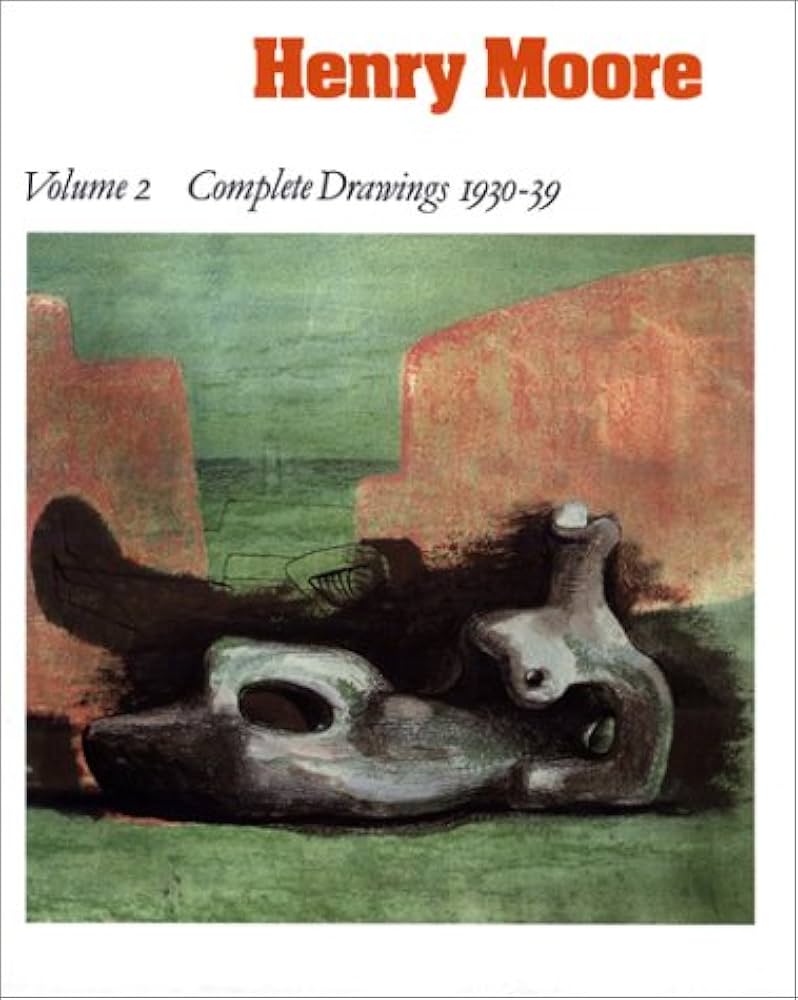
Henry Moore: Complete Drawings Volume 2 1930-39
Henry Moore: Complete Drawings Volume 2 1930-39
Couldn't load pickup availability
Limited availability. First Edition hardcover.
Please note there is some discolouration to the pages and there is some warping in the dust jackets because these copies have been stored since 1998. This is reflected in the price, no refunds or replacements will issued.
On New Year's Day 1930 Moore was thirty-one, recently married, living in a flat in London, enjoying a steady income from his post as a sculpture tutor at the Royal College of Art and, most important of all, continuing to work on his sculpture and drawings. By the time the decade drew to a close, Britain was at war and Moore, too old to fight a second time for his country, must have regarded his future as an artist with much uncertainty. Even so, what he had achieved in those ten years would probably have ensured his reputation as a sculptor of international importance whatever the subsequent history.
Moore always preferred the countryside to the city and in 1931 the Moores bought a tiny cottage at Barfreston in Kent, where he could work in the open air. In the objets trouves picked up among the gnarled roots and branches around the cottage, or while on holiday on the East Anglia coast, Moore found the inspiration for what he called Transformation drawings. This series, which began as a record of a lobster claw, an animal bone or pebbles with holes worn through by the sea, became, in Moore's imagination, reclining figures or mothers holding children. Some of these sketches were developed into small carvings. The sculptor also continued to draw from life; in the first five years of the decade his wife Irina posed for several drawings.
Moore had a brief and somewhat tentative encounter with the Surrealist movement in the mid 1930s. He was not interested in revolution but in the Surrealist approach to the object, to the notion of mystery and the concept of metamorphosis. Although Moore also experimented with with abstract forms, which bear similarities to the flat spatial planes of Ben Nicholson or Piet Mondarian, and created stringed compositions reminiscent of the Constructivist works of Antoine Pevsner and Naum Gabo, his absorbing interests were the human body and organic form. In this highly inventive era, Moore began using brightly coloured crayons and washes - leading to his discovery of the wax resist method which he developed to great effect in the Shelter drawings of the 1940s.
Shipping & Returns
Shipping & Returns
General shipping information
UK delivery
Shipping is calculated at checkout based on the size and weight of the item.
We aim to ship orders within 3 working days via Royal Mail.
Please be aware that we ship from two locations, Leeds and
Hertfordshire, and therefore your order may not arrive together. There
may also be two postage fees, which will be clearly displayed at the
checkout stage of your purchase.
International delivery
We do not ship internationally.
Custom print orders
Custom prints are made to order by our partners King and McGaw, so take a little longer to prepare.
King and McGaw aim to dispatch custom prints within 2-4 weeks.
Refunds and returns
Please contact us at shop@henry-moore.org
if you have any queries regarding returning damaged or faulty items, or
have simply changed your mind about a purchase. We are happy to refund
any items that are returned in saleable condition and in their original
packaging.
For items returned that are not damaged or faulty, the buyer is
responsible for the cost of postage. With proof of purchase items can be
returned in person at our on-site locations.